
A portable camping shower is one of those items people buy in a hurry before a trip and then regret. The specifications look similar across every listing, so it is easy to pick on price and end up with something that runs for eight minutes and produces a dribble.
There are only four things that actually decide whether one is any good. Get those right and the rest is detail.
1. Battery capacity, and what it really buys you
Capacity is quoted in mAh. A 6000mAh battery is a reasonable benchmark for a pump-style shower and typically gives somewhere around two hours of continuous running, which in practice is several showers rather than one.
The number that matters more than the headline figure is how the pump is used. Almost nobody runs a camping shower continuously. You wet, you stop, you wash, you rinse. Used that way, a decent battery covers a weekend for two people without a recharge.
Check that it charges over USB. A shower that needs a proprietary charger is a shower you will eventually not be able to charge.
2. How it draws water
Most portable showers are a submersible pump on a cable. You drop the pump into a bucket, a jerry can, a lake or a sink, and it pushes water through a hose to a shower head.
That design matters because it means the shower has no tank of its own. Your water supply is whatever container you have, which is usually a good thing: a 20 litre bucket gives you far more water than any built-in tank would.
Look at the cable length between the pump and the head. Too short and the bucket has to sit awkwardly close. Anything around two metres or more gives you room to work.
3. Spray modes and pressure
Pressure is what separates a usable shower from a trickle. Multiple spray modes are genuinely useful rather than marketing: a wide soft spray for rinsing yourself, a narrower jet for washing a dog, sand off feet, or muddy boots.
Two speed settings are worth having as well. The lower speed uses less battery and less water, which matters when your supply is a single container.
4. What you can actually mount it on
This is the part people forget. A shower head with nowhere to hang is a shower you hold in one hand while trying to wash with the other.
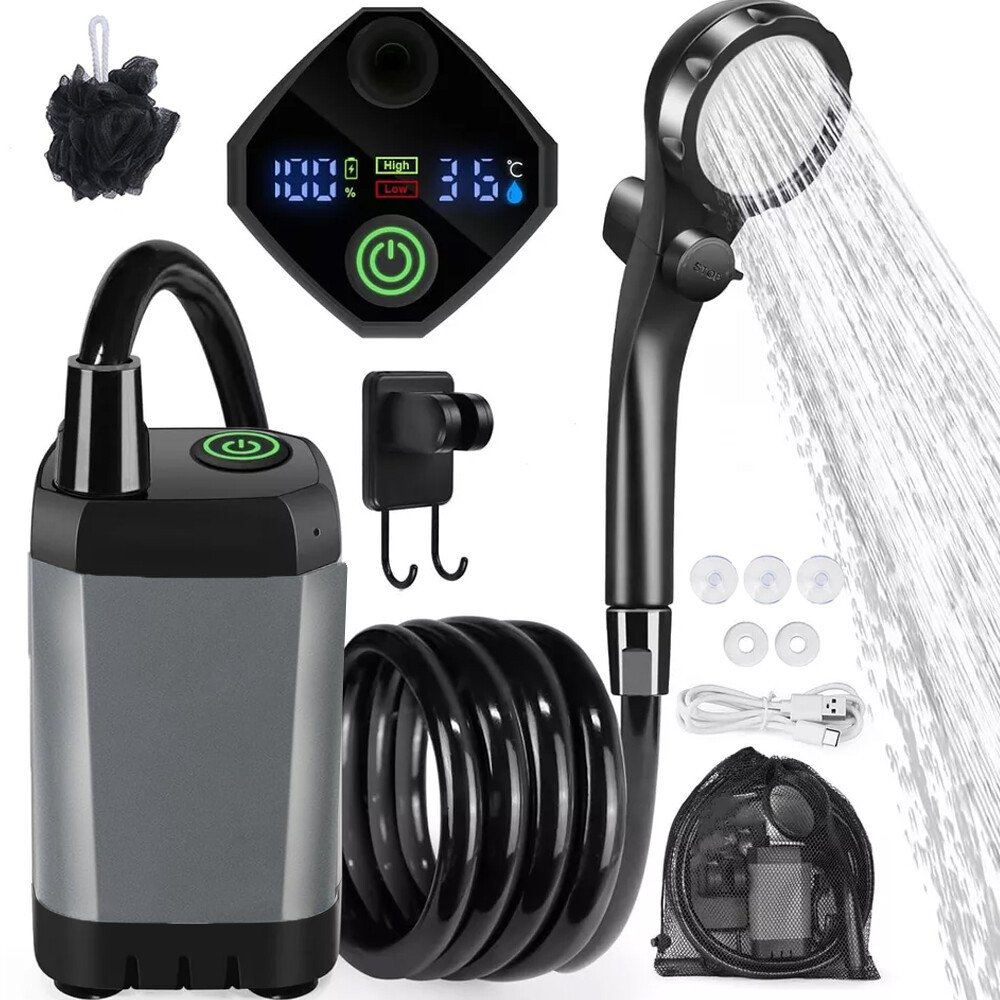
Look for a kit that includes a bracket, suction cups and hooks. Suction cups work on a campervan window or a tiled surface. Hooks work on a tent frame, a branch, a roof bar or a shower rail. Between them you can usually rig something anywhere.
Details worth checking before you buy
- Is there a screen showing water temperature and battery level? Useful, because it stops you guessing.
- Is the pump fully submersible, or only splash resistant?
- Does it come with a carry bag? These have a lot of loose parts.
- Can it run while charging, or does it have to be off?
Where a portable shower actually earns its place
Camping is the obvious use, but it is not the most common one. People buy these for washing dogs outside rather than in the bath, rinsing wetsuits and kit at the beach, washing down bikes, campervans and boats, and for garden and allotment use where there is no tap with a hose.
They are also genuinely useful in a house with no outside tap, which describes a lot of UK flats and terraces.
A straightforward pick
If you want one that covers all of the above, the rechargeable portable camping shower in our range runs off a 6000mAh USB battery, has four spray modes and two speeds, an LED screen for water temperature and battery, and ships with a bracket, three suction cups, two hooks and a carry bag.
You can see the rest of the range in Travel and Portable Gadgets.