
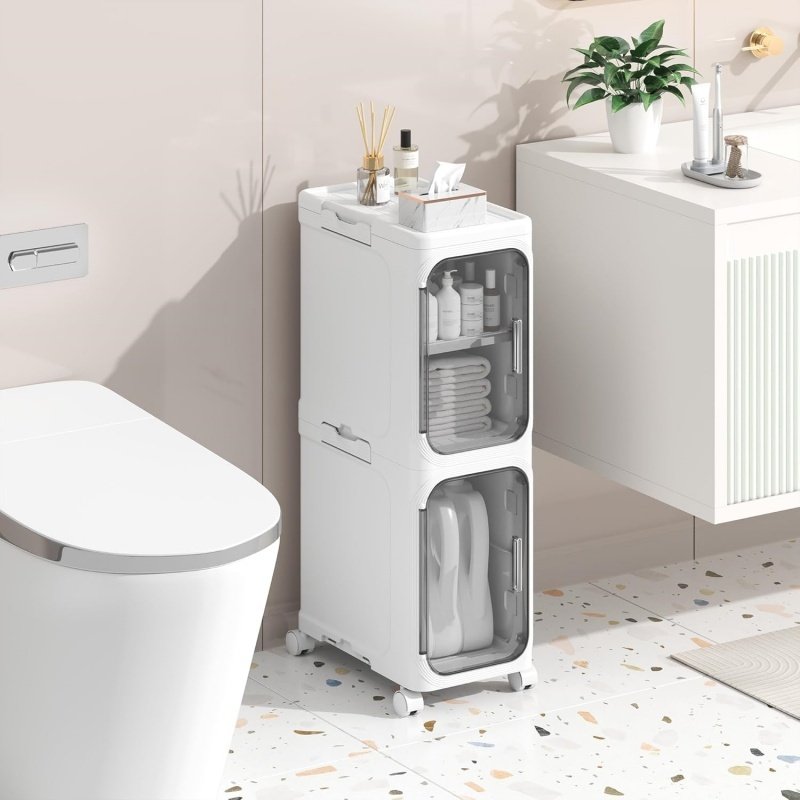
Storage is the thing most people get wrong in a small bathroom. The instinct is to buy a big unit and hope it swallows everything. In a room that is already tight, a big unit just makes the floor feel smaller and the clutter stays exactly where it was, on the windowsill and around the basin.
The approach that works is different. You look at what is actually sitting out, decide where each of those things should live, and then buy the smallest thing that solves it. Here is how to work through it.
Start with what is on the surfaces
Before buying anything, take everything off the basin, the cistern and the bath edge and put it on the floor. Almost everyone finds three groups: things used every day, things used occasionally, and things nobody has touched in a year.
The third group is the easy win. Bin it or move it out of the bathroom. The second group needs a closed home. Only the first group has earned the right to sit out.
Use the gap you are already ignoring
Most bathrooms have a narrow gap somewhere. Beside the toilet, next to the basin pedestal, between the bath and the wall. It is usually somewhere between 15cm and 25cm, which is too narrow for a normal cabinet, so it stays empty.
That gap is the single most useful piece of space in a small bathroom, because filling it costs you no floor you were actually using. A slim gap organiser with drawers is designed for exactly this, and the closed drawers matter more than the capacity. Open shelving in a bathroom collects dust and damp; drawers do not.
Measure the gap at the narrowest point, not the widest. Skirting boards, pipe boxing and tile edges all steal a centimetre or two, and a unit that will not slide in is worse than no unit at all.
Go vertical before you go wide
Floor space is the scarcest thing in a small bathroom. Wall space usually is not. A wall mounted hook rail takes almost no depth and gets towels, robes and a hairdryer bag off the back of the door, where they always end up half falling.
If you rent and cannot drill, look for a rail that offers an adhesive fixing as well as screws. Adhesive fixings have a real weight limit and a damp bathroom wall is not a forgiving surface, so keep them for towels and light items rather than anything heavy, and press the pad on to a clean, fully dry, non-textured surface.
Where drilling is not an option at all, a free standing towel rail does the same job on a small footprint. It will not hold as much as a heated rail, but it lets towels hang open and dry properly instead of sitting folded and damp, which is the actual reason bathroom towels start to smell.
Make one thing mobile
The item that saves the most stress in a small bathroom is usually the one that moves. A trolley cart on wheels holds the cleaning products, the spare toilet rolls and the overflow from the cabinet, then rolls out of the way when you need the floor for anything else.
It also solves the shared bathroom problem. If two people have completely different products, one trolley each is far less annoying than negotiating a single cabinet.
Two things worth doing that are not storage
A larger mirror does more for a cramped bathroom than another shelf. A 61cm round wall mirror bounces whatever light you have and visually pushes the wall back. Round frames also read as less bulky than square ones in a tight space.
The second is simply having fewer, better towels. Three good towels that dry quickly beat eight thin ones that never fully dry and take up a whole shelf.
A simple order to work in
- Clear the surfaces and throw out what you do not use.
- Measure the narrow gap and fill it with a closed unit.
- Put hooks or a rail on the wall for towels.
- Add one mobile trolley for everything that has no fixed home.
- Only then consider anything larger.
Done in that order, most small bathrooms never need the big unit at all.
You can browse the full range in Bathroom Storage, or start with Storage & Organisation for the rest of the house.
If your bathroom is an open wet room rather than a standard bathroom, the rules change quite a bit. Our guide to wet room storage ideas covers that situation.