
Tyre pressure is the cheapest bit of car maintenance there is, and the one most people skip. It affects your braking distance, your fuel bill, how long your tyres last and whether your car passes its MOT. It takes about five minutes a month.
The short answer
Your car’s correct tyre pressure is printed on a sticker inside the driver’s door frame, and also in the handbook. It is not printed on the tyre. Check the pressures when the tyres are cold, at least three to four hours after driving, and check them roughly once a month and before any long journey.
The rest of this guide explains where to find the numbers, why cold matters so much, and the mistakes that make most home checks inaccurate.
Where to find your car’s correct tyre pressure
There are three reliable places, in order of convenience:
- The driver’s door frame. Open the driver’s door and look at the pillar or the door edge. Most cars carry a sticker there with the recommended pressures.
- The fuel filler flap. Some manufacturers put the placard here instead.
- The handbook. Always has it, usually in the technical data section at the back.
The one place the answer is not is the tyre sidewall. The number moulded into the rubber is the maximum pressure the tyre can safely hold, not the pressure your car is designed to run. Inflating to the sidewall figure is a common and genuinely harmful mistake.
Why there is more than one number
Most placards list at least two sets of figures: one for normal use with a couple of people on board, and one for a fully loaded car. The RAC notes there will be different pressures for a fully loaded and an unloaded vehicle, so if you are driving to the airport with four adults and a boot full of luggage, use the higher figures.
Many cars also list different pressures front and rear. Front tyres usually carry the engine and steering load and often need more air. Do not assume all four are the same.
Why tyres must be checked cold
This is the part that catches everyone out. Driving heats the air inside the tyre, and warm air expands. A tyre checked straight after a motorway run can read several PSI higher than its true cold pressure.
If you then let air out to bring it back to the placard figure, you have just underinflated your tyre. When it cools, it will be below spec.
The RAC advises allowing three to four hours after driving before checking. In practice, first thing in the morning on the driveway is the ideal time. If you have to use a garage air line, drive there gently and go no more than a mile or two, and accept the reading will be slightly optimistic.
How to check your tyre pressure, step by step
- Park on level ground with the tyres cold and the handbrake on.
- Find your figures on the door frame placard. Note whether they differ front to rear, and whether you are loaded.
- Unscrew the valve cap and keep it somewhere you will not lose it. Do this one wheel at a time.
- Press the gauge squarely onto the valve. A short hiss as you connect is normal. A continuous hiss means it is not seated straight, so pull off and try again.
- Read the pressure and compare it with your target.
- Add or release air until it matches. Recheck after adjusting.
- Refit the valve cap. It keeps dirt and water out of the valve, which is what makes valves leak over time.
- Do not forget the spare if your car has one. A flat spare is not a spare.
PSI and bar are two units for the same thing. Roughly, 1 bar is about 14.5 PSI. If your placard is in bar and your gauge reads PSI, most digital gauges let you switch units.
What the TPMS warning light actually means
Most modern cars have a Tyre Pressure Monitoring System. The dashboard symbol is usually a yellow horseshoe shape with an exclamation mark inside it.
According to the RAC, the light comes on when one or more tyres are under-inflated by around 25% or more. That is a useful safety net, but it is a late warning, not a substitute for checking. A tyre can be 15% low, costing you fuel and wearing unevenly, without ever triggering the light.
Two other things worth knowing. TPMS checks were added to the MOT test in 2015, and if the warning light is on, that is an instant fail. And there are two types of system: direct, which uses a sensor inside each wheel, and indirect, which infers pressure from wheel rotation speed via the ABS sensors. Indirect systems usually need resetting after you adjust pressures, which is normally a button or a menu option rather than a garage visit.
How often should you check?
Once a month is the standard advice, plus before any long journey and before carrying a heavy load. Tyres lose air naturally through the rubber and the valve even when nothing is wrong, so a slow drift downwards is normal rather than a sign of a puncture.
Cold weather is worth a special mention in the UK. Air contracts as temperature drops, so pressures that were correct in September can read noticeably low by December without a single thing having leaked. A check when the weather turns is worth doing.
What underinflation and overinflation actually do
Underinflated tyres flex more at the shoulders, so more of the tyre touches the road than it should. The RAC points to two consequences: the added friction from that larger contact area leads to premature wear at the edges of the tyre, and the tyre needs more force, and therefore more fuel, to turn.
Overinflation does the opposite. The tyre bulges in the middle, so the centre of the tread carries the load and wears out first, and the contact patch shrinks, which can lengthen braking distances.
A quick way to read your own tyres: even wear across the tread means your pressures are about right. Worn edges with a good middle means chronic underinflation. A worn middle strip with good edges means chronic overinflation.
Check the tread while you are down there
You are already crouched by the wheel, so it costs nothing. In the UK the legal minimum tread depth for a car is 1.6mm across the central three-quarters of the tyre and around its complete circumference.
The penalties are serious. The RAC states a fine of up to £2,500 and three penalty points per tyre. Four illegal tyres can mean twelve points, which is a licence.
Legal is not the same as safe, though. Safety specialists recommend replacing at 3mm, because wet stopping distances increase sharply below that. The RAC cites testing showing wet braking distance can differ by as much as 44% between a 3mm tyre and one worn to 1.6mm.
The easiest home check is the 20p test. Push a 20p coin into the main tread grooves. If the outer band of the coin is hidden, you have more than the legal minimum. If you can see that outer band, get the tyre looked at.
Do you need your own inflator?
Not strictly. Garage air lines are free or near enough, and a £5 pencil gauge will tell you where you stand.
The honest case for owning one is that people who have an inflator at home actually check their tyres, and people who have to make a special trip mostly do not. There is also the cold-tyre problem: you cannot get a true cold reading at a garage forecourt three miles from home, because by the time you arrive the tyres are warm.
If you do buy one, the things that matter are:
- Auto shut-off. You set the target pressure and it stops there. Without it you are watching a gauge and guessing.
- How it is powered. A rechargeable unit works on a driveway with no engine running. A 12V socket lead is the backup you want if the battery is flat when you need it.
- Realistic inflation time. A compact inflator topping a car tyre up by a few PSI is quick. Filling a fully flat tyre takes several minutes, and that is normal for this size of unit.
- Nozzles included. A Presta or ball adapter means the same unit does bikes and footballs, which is usually where it earns its keep.
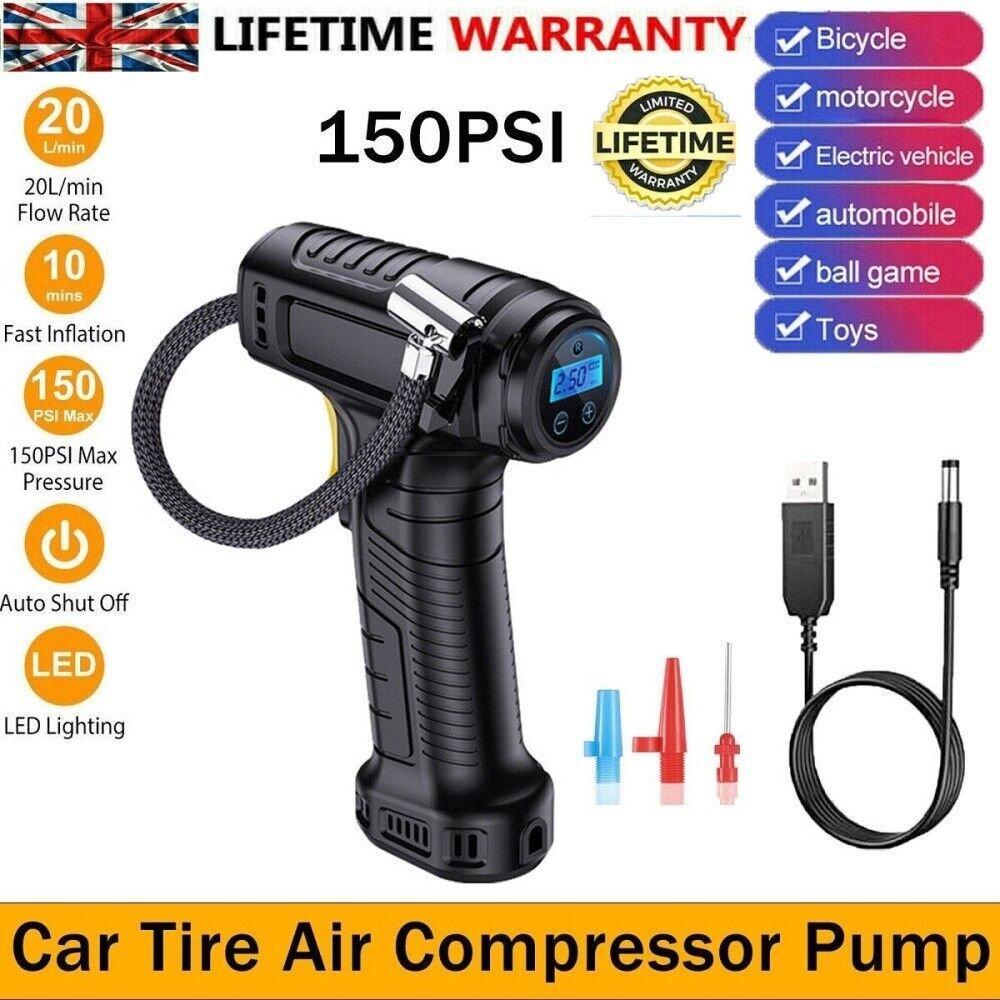
Our cordless car tyre inflator covers that list: a digital gauge with automatic shut-off at your set pressure, rechargeable with a 12V car socket as backup, around five to six minutes to inflate a car wheel, an LED light for roadside use in the dark, and three nozzles in the box. You can see the rest of the range in Car Gadgets, or browse everything for the car in Car & Automotive.
Common mistakes
- Using the number on the tyre sidewall instead of the door placard.
- Checking warm tyres and then letting air out.
- Setting all four wheels the same when the placard specifies different front and rear figures.
- Ignoring the loaded-vehicle column before a holiday drive.
- Treating the TPMS light as the trigger to check, rather than a last resort.
- Forgetting the spare.
Frequently asked questions
Is tyre pressure checked in the MOT?
Pressure itself is not a pass or fail item, but tyre condition and tread depth are, and an illuminated TPMS warning light is an automatic failure.
Can I check tyre pressure without a gauge?
Not accurately. A tyre can be 20% underinflated and still look completely normal. Radial tyres are designed to have a slight bulge at the bottom, which is why eyeballing them tells you almost nothing until they are dangerously flat.
Should I add extra pressure in winter?
No. Set the placard pressure as normal, but check more often, because cold air contracts and readings drift down as temperatures fall.
How much air do tyres lose normally?
A slow, gradual loss over weeks is expected through the rubber and valve. A tyre that needs topping up every few days has a problem and should be inspected.
The takeaway
Find the placard in your driver’s door frame, check all four tyres cold once a month, use the loaded figures when the car is full, and do the 20p test at the same time. That is the whole job, and it is the highest-value five minutes you can spend on your car.
More practical guides are in Trendupia Discover.
Sources: RAC, how to check your tyre pressure; RAC, TPMS guide; RAC, tyre tread depth and UK law. This guide is general information, not a substitute for your vehicle handbook or a qualified tyre fitter.